
Which grip socks for football? Here's what to look out for.
Grip socks can now be seen on almost every football pitch. From youth players to professional footballers: more and more players are swapping their regular sports socks for socks with grip. But when you then go looking for a pair, you will soon discover that there is quite a difference between grip socks.
Thick or thin socks, different types of grip, compression, low and high models, and sometimes surprisingly wide size ranges. What should you actually look out for when choosing grip socks for football?
Ultimately, the most important thing is quite simple: a good grip sock must ensure that your foot sits as stably as possible in your football boot. And for that, more is needed than just a few rubber studs under a sock.
Why grip socks in football?
While playing football, your body constantly changes direction. You sprint, slow down, turn away from an opponent, or push off for a shot. Your football boot moves with you, but you want to prevent your foot from shifting unnecessarily inside the boot.
That is exactly what grip socks are intended for.
The grip zones under the sock increase the friction between your sock and the inside of your football boot. This allows your foot to remain more stable in the shoe.
That doesn't mean, however, that grip socks will suddenly make you shoot harder or sprint faster. It doesn't work that simply. They can, however, reduce some of the unwanted movement inside your shoe. And especially in a sport where you are constantly accelerating, decelerating, and changing direction, that can be beneficial.
Do you want to know in more detail why footballers use them? Then read our blog as well. Why do professional footballers wear grip socks?.
The washing machine is not the enemy of your grip socks.
There is still sometimes the idea that grip socks should only be hand-washed. Fortunately, you don't have to sit with a basin next to the washing machine after every football training, running session, or padel match.
GXOX grip socks can simply be washed in the washing machine.
We recommend a maximum temperature of 30 degrees. For normal maintenance, that is sufficient, and at the same time, you prevent the socks from being unnecessarily exposed to higher temperatures during every wash.
A normal or gentle wash program is fine. So you don't need to look for a special three-hour program that even your washing machine manufacturer doesn't know exactly what it's intended for.
It is wise, however, to check what else is in the drum. Open zippers, Velcro, and hard parts on other garments can rub against the socks during washing. If you want to prevent this as much as possible, you can put your grip socks in a laundry bag.
It is not necessary. View it primarily as simple extra protection.
1. Look beyond just the grip studs
The first thing you probably look at is the bottom. That makes sense, because that is where the grip zones are. However, the number of studs alone doesn't say much.
More important is that the grip is located in the right places under the foot and makes sufficient contact with the inside of your shoe. A lot of grip material on a poorly fitting sock solves little if the sock itself subsequently moves around your foot.
A grip sock functions as part of a chain:
foot → sock → football boot
You want to limit movement between those different layers as much as possible. That is why the fit, material, and construction of the sock also play an important role.
2. The right size is more important than you might think
With grip socks, you sometimes see quite wide size ranges. For example, one size can be considered suitable for a large number of different shoe sizes. This is easy to understand from a production and inventory perspective. The fewer sizes you offer, the fewer different variants you need to produce and keep in stock.
For a grip sock, however, there is another side to the story: the fit.
Someone with shoe size 39 simply has a smaller foot than someone with size 46. If the same sock has to fit both feet, the material must be able to accommodate that difference. With a regular sports sock, that doesn't necessarily have to be a major problem. But with a grip sock, you buy the sock precisely to restrict movement.
A grip sock that is too large can provide excess material or sit less snugly around the foot. If it is too small, the material is stretched further, and the heel and grip zones, for example, may end up positioned differently than intended.
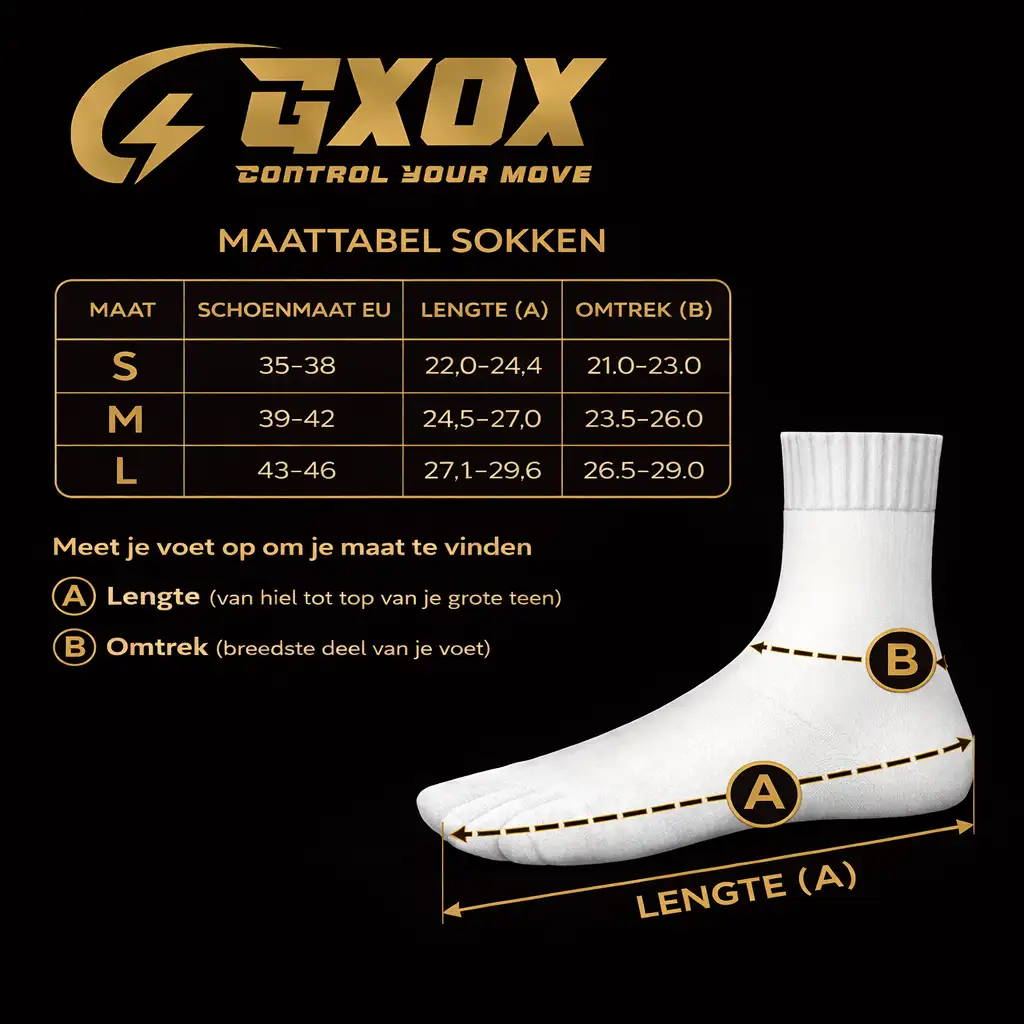
Therefore, we find smaller size ranges for grip socks more logical. GXOX uses three sizes for its grip socks:
35–38, 39–42 and 43–46.
For us, that means more variants to produce and keep in stock. Nevertheless, we made this choice deliberately. Not because a grip sock needs to fit precisely to the millimeter, but because grip is of little use if the sock itself does not fit properly around your foot.
In short: When choosing grip socks, check not only whether your shoe size is listed on the packaging, but also the full size range.
3. Pay attention to the thickness of the sock
Thicker is not automatically better. Football boots often fit quite snugly around the foot. That is intentional: too much room in the shoe can actually cause movement.
A very thick grip sock can therefore change the fit of your football boot, especially when your shoes are already quite tight. On the other hand, you don't want the sock to be so thin that it offers hardly any comfort or moisture absorption.
A good football sock therefore seeks a balance: sufficiently soft and comfortable under the foot, without adding unnecessary bulk to the shoe.
Do you regularly feel like your foot moves despite having the correct shoe size? Incidentally, that is not always due to your socks. Why do my feet slide inside my shoes? we explain what other causes might be behind that.
4. Material and moisture also play a role
Playing football means sweating. That includes your feet. That is why grip on the outside of the sock is not the only important factor. The material must also remain comfortable during training or a match. A breathable construction can help wick away heat and moisture, while the material under the foot must be able to absorb sufficient moisture.
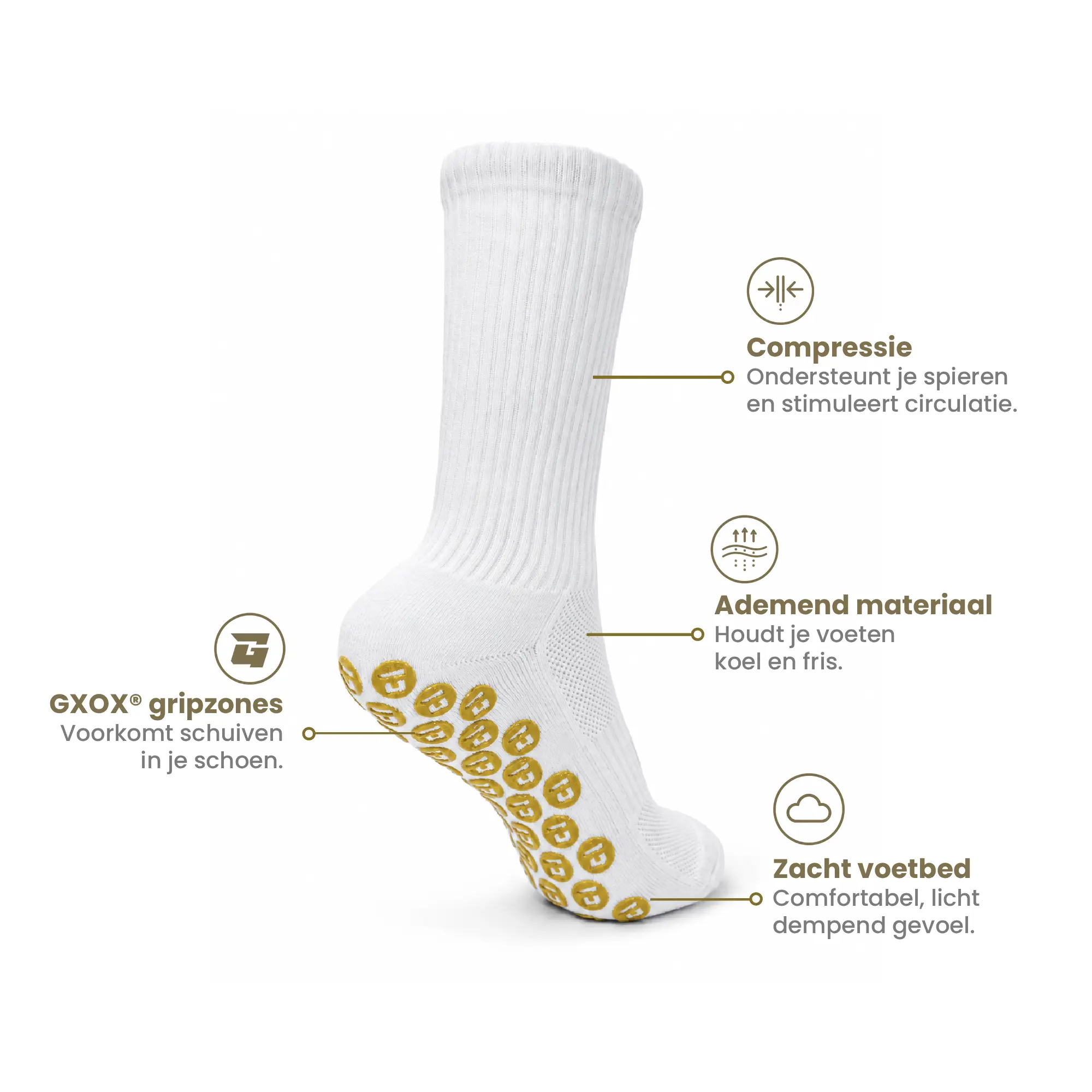
At GXOX, for example, we have therefore opted for a cotton footbed combined with a more breathable mesh upper.
That is not a spectacular feature that you see from the sidelines. But after ninety minutes of football, it is precisely these kinds of details that are often more important than how impressive a grip sock looks when you take it out of the packaging.
5. A grip sock should not only provide grip under your foot
There is another form of movement that is less frequently discussed: the sock itself. When a sock sits loosely around the foot or ankle, it can shift or crease during sports. Therefore, some grip socks use a form of elastic support or compression around the foot and ankle.
The purpose of this is not to completely immobilize your ankle. After all, a sock is not a brace. It primarily helps to keep the sock in place.
That actually aligns with the same principle as the grip zones under the foot: you try to reduce unnecessary movement between foot, sock, and shoe.
6. Low, mid-length, or long grip socks?
Then a practical choice remains: the height.
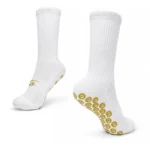
Mid-length grip socks are particularly widely used in football. You wear them under your cut-off match sock or in combination with a sleeve, so that you can match the grip of the sock with the colors of your club kit. That is also the reason why you regularly see tape around the transition between the two socks on professional footballers.
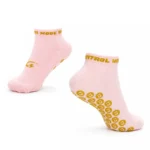
However, a mid-length sock is not necessary for everyone. Some players find a lower model more comfortable, while others prefer to feel more support around the lower leg. The height does not change the basic principle of the grip under your foot. Therefore, above all, choose a model that suits the way you wear your football socks and shin guards.
Long grip socks
Mid-length grip socks
Ankle grip socks
So, what are the best grip socks for football?
There is no single grip sock that is automatically the best for every footballer. However, there are a number of characteristics that combine to make a good grip sock. The sock must fit snugly around your foot, the grip zones must be in the right places, the material must remain comfortable during sports, and the thickness must match your football boots.
And do not underestimate the scale.
Precisely because the purpose of a grip sock is to reduce movement, it is strange to look only at the grip on the bottom and ignore the fit of the sock itself. If you wear size 39, a sock also intended for someone with size 46 does not necessarily fit poorly. However, when you can choose a sock made more specifically for your foot size, we consider that a logical choice for a grip sock.
Ultimately, it is not about getting as much grip as possible. It is about control.
Would you like to see how we have incorporated these principles? Then take a look at our grip socks for football.
Ready for a new pair of grip socks for football?
Whether you choose a low, mid-length, or long model: the basics remain the same. A good fit, grip zones under the foot, and a design that suits the sport you practice.
View our GXOX grip sock collection and choose the version that best suits your sport.
White grip socks
Black grip socks
Fluorescent grip socks
Would you like to know more about grip socks in general? Then these articles are also interesting:
- Do grip socks really work?
- Why do your feet slide inside your shoes?
- Do grip socks prevent blisters? This is what practice and science say.
- What are GXOX grip socks
- Why do you get holes in your socks?