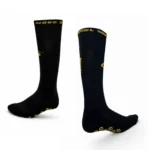

Why do pro players wear grip socks?
If you watch matches during the 2026 World Cup, one thing immediately stands out. It is not just the latest football boots that attract attention. A striking number of players are also wearing grip socks under those boots.
In fact, whereas grip socks were worn mainly by a small group of pros a few years ago, they seem to have become almost the standard in top-level football these days. That raises a logical question.
Why do so many professional footballers wear grip socks?
Is it marketing? Is it fashion? Or does it actually deliver benefits?
The short answer: probably a combination of all of them. But there is now also scientific research showing that grip socks can actually influence how your foot behaves in your shoe during sports.

Play yourself with more grip in your football boots?
Check out our grip socks for football.
Football is about millimeters
Football is a sport of details. A striker who can turn half a second earlier. A defender who stays just a little more stable during a duel. A midfielder who changes direction faster. These are often the moments that decide matches.
When you sprint, brake, or change direction, a lot of force is generated between your foot and your shoe. If your foot shifts inside the shoe during this process, some of that force is lost. That is exactly the problem that grip socks for football try to reduce.
By creating extra grip between the sock and the shoe, the foot stays in place better.
What does scientific research say?
In 2022, researchers from Nottingham Trent University published a study regarding the effect of grip socks on sports performance. This involved examining grip, foot movements inside the shoe, and performance during rapid changes of direction.
The researchers discovered that:
- grip socks created almost twice as much friction as regular sports socks;
- the foot shifted less in the shoe;
- participants completed a slalom course faster with grip socks than with regular sports socks.
The researchers' conclusion was strikingly clear: the tested grip socks improved the agility of both male and female athletes.
A second study A 2023 study specifically investigated grip socks in footballers. In doing so, researchers observed that players were able to utilize more grip and traction during certain changes of direction and that they felt themselves faster when wearing grip socks.
The test's final time did not improve significantly in that study, but the researchers did conclude that the relationship between grip, stability, and performance is complex and depends on multiple factors, such as shoe choice and playing style.
So do grip socks really work?
Based on current research, the answer appears to be: yes.
But perhaps not in the way many people think. Grip socks don't suddenly turn you into Kylian Mbappé. They primarily ensure that your foot moves less inside your shoe and that you experience more control during explosive actions. That might sound like a small detail. Until you consider that professional clubs invest millions to make players one percent better.
If grip socks offered no advantage at all, they would probably have disappeared from professional football long ago. The exact opposite seems to be happening.
Why professional footballers often embrace new developments sooner
Professional footballers have access to something that most amateurs do not have:
- sports scientists;
- performance coaches;
- data analysts;
- physiotherapists;
- materials experts.
Every training session is measured. Every sprint is recorded. Every improvement is analyzed.
When a product is used by an increasing number of pros for years, it is usually not because it looks nice. Ultimately, professional football is about performance.
That does not mean that every player experiences exactly the same benefit, but it does mean that thousands of training hours and experiences have contributed to the enormous popularity of grip socks.
The mental advantage is often forgotten
There is another aspect that is often underestimated.
To trust.
In the 2023 study, players indicated that they felt faster when wearing grip socks. That might seem unimportant. But sports psychologists have known for years that confidence influences performance. When a player feels that he has more grip, stands more stably, and can react faster, he will often move more convincingly as well.
Or as many footballers would say themselves:
“If it feels good, you play more freely.”
Why do we see grip socks mainly in football?
That is actually an interesting question. Because the benefits found in studies are not exclusive to football.
Also in sports such as:

Rapid changes of direction occur. Forces between foot and shoe are generated there as well. There, too, you want to prevent your foot from sliding unnecessarily.
Football simply often leads the way when it comes to material innovation. What becomes commonplace there is often seen in other sports a few years later.
Are grip socks something for you?
If you play a sport where speed, control, and stability are important, then grip socks are definitely worth trying.
The scientific studies show that grip socks:
- increase the grip between foot and shoe;
- reduce the movement of the foot in the shoe;
- improve the sense of stability;
- can improve performance in specific situations.
That probably explains why so many players are playing with grip socks during the 2026 World Cup.
Not because it is a hype. But because every small improvement counts.
Do you want to use grip socks yourself while playing football? Then grip isn't the only important factor. The size, fit, thickness, and material also determine how the sock ultimately sits in your football boot. Therefore, read also What to look out for when choosing grip socks for football.
View our football grip socks and choose the length that best suits your way of playing and wearing.
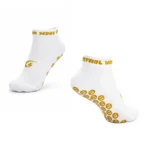
Ankle grip socks
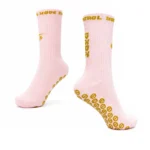
Mid-length grip socks