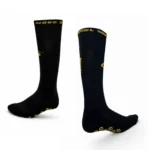

Do grip socks prevent blisters? This is what practice and science say.
Every athlete knows the feeling. You’re out and about, the competition has just started, or you’re in the middle of a long training session. Everything feels good, until at some point you notice something starting to chafe. At first, you ignore it. Then, unconsciously, you start walking differently. By the time you take off your shoes, you basically already know what time it is: a blister.
The annoying thing about blisters is that they often appear at the most inconvenient times. Just during an important tournament, a long training run, or that one football match you've been looking forward to for weeks. And perhaps even more frustrating: many athletes think that blisters are just part of the game. That they are simply the result of intense exercise.
Fortunately, the reality is a bit more nuanced. After all, blisters don't just appear out of nowhere. In fact, scientific research has given us a pretty good understanding of what causes them and which factors increase or decrease the likelihood. This also means that you have more influence over them than many people think.
One of the solutions that more and more athletes are opting for is grip socks. They are now worn by footballers, runners, tennis players, padel players and athletes in all kinds of other disciplines. But do grip socks actually help prevent blisters, or is it mainly a clever marketing term?
In this article, we look not only at practical experiences but also at what science says about the subject. This gives you an honest picture of what grip socks can and cannot do if you regularly suffer from blisters.
How do blisters actually form?
To understand why grip socks can help, it is first important to know exactly how a blister forms. Many people think that a blister is simply the result of friction against the skin. That sounds logical, but the story is a bit more complicated.
When you move, your foot constantly wants to make small movements inside your shoe. With every step, you slow down, push off, change direction, or absorb a landing. During all these movements, various forces act on your foot. The skin does not always move precisely along with the underlying tissues.
That is precisely where the problem arises.
Scientists refer to this as shear forces, in other words, shear forces. These shear forces cause different layers of skin to move relative to each other. When this happens often enough, the connections between those skin layers become damaged. The body then reacts by accumulating fluid between the skin layers. That fluid eventually forms the blister that almost everyone has had at some point.
This also means that a blister does not form immediately because the outside of your skin rubs against your sock. The damage actually begins deeper in the skin, long before you see anything on the outside.
Compare it to a stack of playing cards. When you hold the top card and slowly slide the bottom one, all the cards move slightly relative to each other. If you do that often enough, tension builds up between the layers. It works exactly the same way in your skin while exercising.
Why do some athletes get blisters much more often?
Perhaps you know someone who runs a half marathon effortlessly in new shoes, while you feel things are going wrong after just an hour of football. That has little to do with bad luck and a lot to do with the conditions in which your feet have to work.
The biggest culprit is movement between three parts: your foot, your sock, and your shoe. The more these move independently of each other, the greater the shearing forces on the skin become.
You see this especially in sports involving many explosive movements. Think of football, hockey, tennis and padel. You sprint, brake abruptly, turn away from an opponent, and constantly change direction. With every action, your foot slides a tiny bit inside the shoe. On its own, this is barely noticeable, but after hundreds or even thousands of repetitions, it can be enough to cause a blister.
Runners also regularly deal with this. Although the movement is less explosive, the same spot is sometimes stressed tens of thousands of times during a single long run. A minute shift that poses no problem during the first kilometer can suddenly cause irritation after twenty kilometers.
Moisture plays an equally important role in this. Your feet sweat while exercising. That is perfectly normal; every foot has thousands of sweat glands. When moisture is not properly drained, the structure of the skin changes. The skin becomes softer and more vulnerable, allowing shearing forces to cause damage more quickly. This also explains why many athletes suffer from blisters more frequently, especially during warm days or long training sessions.
In addition, ill-fitting shoes are still a common cause. If shoes are too loose, the foot literally has room to move back and forth. If they are too tight, pressure points develop that also increase the risk of blisters. So, it is not just the quality of your shoes that counts, but especially how well they actually fit your feet.
And then, of course, there are the socks. That component often receives surprisingly little attention, even though the sock forms the direct connection between your foot and your shoe. A cotton sports sock that slowly slips down, forms creases, or retains a lot of moisture creates exactly the conditions in which shearing forces have free rein.
That is also the reason why more and more athletes are not only investing in good shoes, but also taking a critical look at the socks they wear. Whereas in the past virtually every sports sock looked the same, modern grip socks have been developed specifically with the aim of limiting movement between foot, sock, and shoe as much as possible.
Do grip socks really help prevent blisters?
The short answer is: yes, in many cases, grip socks can reduce the risk of blisters. But as with almost everything in the sports world, the answer is a bit more nuanced than a simple yes or no.
After all, a grip sock is not a miracle cure that prevents every blister. Put on a pair of grip socks in shoes that are two sizes too big and you will still have problems. The same applies if you continue exercising all afternoon with soaked socks or if your shoes simply do not fit properly. Nevertheless, more and more athletes are consciously choosing grip socks, and there is a logical explanation for this.
The main difference compared to a regular sports sock lies in the way the foot behaves during movement. With a traditional sports sock, your foot can relatively easily slide a short distance over the insole of your shoe. That movement is often so small that you don't even feel it, but during a match or training, it repeats itself hundreds or even thousands of times. It is precisely these small, repeated movements that cause the shearing forces that can eventually lead to a blister.

Grip socks are designed to limit that unwanted movement as much as possible. The anti-slip layer on the underside ensures that the sock has more grip on the shoe's insole. As a result, your foot remains more stable in place during acceleration, deceleration, and turning. In many cases, less movement also means less shearing force on the skin.
That is precisely the reason why grip socks are nowadays no longer worn only by professional footballers. Also by runners, tennis players, padel players, field hockey players and athletes in the fitness world discovering that a more stable foot not only feels more comfortable, but can also contribute to greater comfort during longer or intensive workouts.
What does science say?
In recent years, there has been increasing research into the causes of blisters and the influence of shear forces on the skin. Although not every study specifically examines grip socks, the results remarkably often point in the same direction.
Researchers now largely agree that the greatest problem is not so much friction on the outside of the skin, but rather the shearing forces generated within the skin. The greater these forces become and the longer they persist, the greater the chance that skin layers will separate and fill with fluid.
That also explains why solutions that restrict foot movement can theoretically have a positive effect. When the foot remains more stable relative to the shoe, shear forces generally decrease.
In addition, various studies show that moisture plays an important role. Wet skin is more susceptible to damage than dry skin. That is why modern sports socks increasingly use materials that wick away perspiration better than traditional cotton. A dry foot not only feels more comfortable but is also less susceptible to the forces that cause blisters.
Another interesting point from the literature is that stability often goes beyond simply preventing blisters. Athletes regularly report that a foot that moves less inside the shoe also provides more confidence during rapid changes of direction. Although this feeling is difficult to measure objectively, it is one of the reasons why grip socks have become so widely accepted within various sports.
Why do so many athletes experience a difference?
Scientific research is important, but ultimately, of course, there are no researchers on the football pitch when you sprint or make a slide. That is why practical application is also interesting.
Ask a group of athletes why they ever switched to grip socks, and the answers are remarkably similar. Some were simply fed up with recurring blisters. Others felt that their foot kept shifting slightly inside the shoe, especially during explosive movements. Still others sought more stability without having to buy new shoes immediately.
However, that does not mean that every athlete will experience exactly the same difference. That depends on many factors. Someone with perfectly fitting shoes will likely gain less than someone whose foot constantly slides back and forth. The type of sport also plays a role. In football or hockey, where there are many short bursts of acceleration and changes of direction, the conditions are very different from those during a relaxed endurance run.
However, you do see one clear similarity: athletes who experience less movement between foot and shoe often describe their shoes as more stable and comfortable. And that is precisely the mechanism for which grip socks are designed.
More than just grip
Moreover, it would be too simplistic to judge grip socks solely on the anti-slip layer. The overall construction of the sock plays at least as significant a role.
A good sports sock fits snugly around the foot without constricting. This creates fewer creases that can cause extra friction during movement. Compression zones around the midfoot and ankle help keep the sock better in place, while breathable materials wick away heat and moisture more quickly. It is precisely all these properties combined that determine how comfortable a sock ultimately feels.
In the development of the GXOX grip socks Therefore, attention was paid not only to grip but also to wearing comfort during intensive sports. For instance, the socks feature a soft cotton footbed, breathable mesh zones on the upper side, and compression zones that contribute to a stable fit. The grip zones on the underside are designed to further limit movement between the sock and the shoe.
Are you curious how exactly these properties work together? Then read our article as well. ‘Do grip socks really work?’, in which we delve deeper into the technology behind modern grip socks. If you first want to know why your feet slide around in your shoes at all, then our blog is also ‘Why do your feet slide inside your shoes?’ An interesting addition. Together, these articles provide a complete picture of what actually happens under your feet while exercising.
When are grip socks less effective?
Although grip socks are a valuable addition for many athletes, it is important to have realistic expectations. They can improve the conditions that lead to blisters, but they do not eliminate all causes. Anyone who claims otherwise does both the athlete and the product a disservice.
One of the most common causes of blisters remains simply a poorly fitting shoe. If a shoe is too big, your foot will still move more than is desirable despite the extra grip. If a shoe is too small, pressure points develop that can also cause irritation and blisters. In both cases, grip socks do not solve the underlying problem.
Moisture also deserves attention. During a warm summer day or an intense workout, your feet produce a surprising amount of sweat. When that moisture is not adequately wicked away, the skin becomes softer and more vulnerable. Modern grip socks are therefore often made of materials that regulate perspiration better than a standard cotton sports sock, but even the best sock cannot prevent wet shoes or prolonged moisture from eventually affecting your comfort.
In addition, acclimatization plays a role. When you buy new football boots or running shoes, your body often needs some time to adjust. Therefore, the first training sessions are not always representative. It is wise to gradually build up new equipment before immediately completing a full match or long run in them. Incidentally, this applies just as much to shoes as to socks.
Anyone who regularly suffers from blisters would therefore do well not to look for a single solution, but to consider the complete picture. The right shoe, a well-fitting sports sock, dry feet, and correct sizing reinforce each other. It is precisely this combination that ultimately makes the biggest difference.
This is how you reduce the risk of blisters
Fortunately, you don't have to be a sports doctor to significantly reduce the risk of blisters. Often, it is precisely the small adjustments that together have a big effect.
Start with your shoes. Make sure they fit well, without your toes getting pinched or your heel lifting while walking. Next, check that your socks don't slip down or form creases. That might seem like a minor detail, but it is precisely those small folds that can cause significant irritation during hundreds of movements.
In addition, try to keep your feet as dry as possible. Breathable shoes and technical sports socks wick away moisture better than traditional cotton socks. If you play multiple matches or training sessions in one day, it can even be pleasant to put on a dry pair of socks in between. Not only does it feel more comfortable, but your skin will probably thank you for it too.
Do you still regularly suffer from sliding feet despite everything? Then grip socks can be a logical next step. They do not change the fit of your shoes, but they can help reduce the unwanted movement between foot, sock, and shoe. After all, that is precisely where a significant portion of the shearing forces originate that are ultimately responsible for many sports blisters.
Conclusion
Can grip socks prevent blisters?
The most honest answer is that they can reduce the risk of blisters, but they offer no guarantee. Science shows that blisters are primarily caused by shearing forces on the skin. Therefore, anything that helps reduce those forces can contribute to a lower chance of blister formation. A more stable foot in the shoe, less unwanted movement, and better moisture regulation all fit within that principle.
This also immediately makes it clear why more and more athletes are opting for grip socks. Not because they expect a miracle cure, but because they strive for more comfort, more stability, and less distraction while playing sports. And let's be honest: if all you can think about during an exciting match is that burning spot under your foot, winning usually doesn't get any easier.
Are you curious if grip socks can make a difference for your sport too? Then check out our GXOX grip socks or read more in our articles about how grip socks work and why feet can slide inside shoes. This way, you get a complete picture of how small details under your feet can make a big difference while exercising.
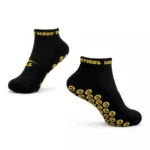
Ankle grip socks
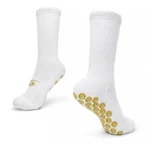
Mid-length grip socks