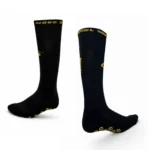

Why do your feet slide around in your shoes? (And how to prevent it)
You probably know the feeling.
You accelerate for a sprint, make a sharp turn, or brake suddenly during a race. At that moment, you feel it. It is not your shoe that moves, but your foot shifts or slips just a little bit inside your shoe.
Sometimes you hardly notice it. Sometimes it feels like you aren't fully secured in your shoe. And sometimes it ends with tired feet, irritation, or even a nasty blister.
Many athletes immediately think that their shoes are too big. While that can certainly be a cause, the reality is often a bit more nuanced. Even in perfectly fitting shoes, your foot can move while exercising.
But why does that actually happen? And more importantly: what can you do about it?
Enormous forces are generated during sports.
When you simply walk, relatively little happens. Your foot moves in a controlled manner and the load remains limited.
That changes completely during exercise.
With every step, sprint, acceleration, turn, or braking action, forces are generated that are many times greater than during normal walking. Your body wants to keep moving forward, while your shoes are actually trying to slow down your movement or change direction.
Compare it to a passenger in a car. When a car brakes suddenly, your body automatically continues to move for a moment. Exactly the same thing happens to your feet while exercising.
Your shoe stops. Your foot wants to move on for a fraction of a second. And that is precisely where the sliding occurs.

A shoe can fit well and still allow movement.
Many athletes assume that a shoe fits well as long as it does not feel loose.
That is understandable, but sports place completely different demands on a shoe than just walking.
A football boot or other sports shoe that feels perfect during the fitting is subjected to hundreds of explosive movements during a match or training. During every sprint, the foot is pushed backwards. During every braking action, the foot moves forward. Subsequently, lateral forces are generated during a quick turn.
Even when a shoe fits well, a small amount of movement always remains possible. That is normal.
The only question is how much movement will be generated.
Why sweat often plays a bigger role than you think
A factor that many athletes underestimate is hydration.
During training or a match, feet get warm. The longer you exercise, the more you sweat. This also changes the friction between your foot, your sock, and the inside of the shoe. That might sound technical, but the effect is simple:
The smoother the surfaces become, the easier your foot can move.
Many athletes recognize this feeling. For the first ten minutes of a match, everything feels stable. As the match progresses, it seems as if you are sliding around a little more in your shoes. That is no coincidence. Moisture, or sweat, often plays an important role in this.
Why is sliding actually a problem?
At first glance, a few millimeters of movement doesn't seem that important. Yet, professional athletes and sports scientists have been paying attention to this for years.
When your foot moves inside your shoe, some control is lost. Not because you can suddenly no longer play sports, but because part of the force you produce is not directly transferred to the ground.
In addition, extra movement causes more friction. And it is precisely this friction that is often the cause of irritation, pressure points, and blisters. Many athletes who regularly get blisters look at their shoes first. While the actual cause sometimes lies in the movement of the foot inside the shoe.
That is why professional athletes pay so much attention to grip.
When you look at professional football, you see that more and more players are paying attention to everything related to grip and stability. You see this reflected in the development of modern football boots, but also in the growth of grip socks for football, which are designed to increase the grip between sock and football boot.
Professional clubs have performance coaches, sports scientists, and data analysts who are constantly looking for ways to optimize performance. Even small improvements can make a difference at the highest level. It is therefore no coincidence that grip socks have become a standard part of the equipment for many professional footballers.
Would you like to know more about this? Then also read:
Why do professional footballers wear grip socks?
Why are more and more athletes using grip socks?
Grip socks have been developed with one clear goal: to limit movement between the foot and the shoe. By creating extra grip between the sock and the inside of the shoe, the foot remains more stable in place during explosive movements.
Scientific research shows that grip socks can increase the grip between the foot and the shoe and reduce movement of the foot inside the shoe. As a result, many athletes experience more control during sprinting, turning, and pushing off.
That does not mean that a grip sock automatically makes you faster or suddenly changes your performance completely. However, it can contribute to a more stable feeling during sports.
And that is precisely the reason why more and more athletes are switching to grip socks.
Can you completely prevent shoes from sliding?
Completely preventing it is probably not possible. During sports, forces always continue to be generated that try to move your foot. However, you can significantly reduce the problem.
A well-fitting shoe forms the basis for this. In addition, it helps to tie your laces correctly and to choose sports socks that offer sufficient grip and support. Limiting moisture inside the shoe can also contribute to a more stable feeling.
Ultimately, it is not about one big solution, but about multiple small factors that together make the difference.
Conclusion
Feet do not always slide because shoes are too big. In many cases, it is simply a result of the forces generated during sports. With every sprint, turn, and braking action, your foot tries to move a little bit inside the shoe.
The more grip there is between foot, sock, and shoe, the smaller that movement becomes. That explains why more and more athletes are paying attention to something that was barely discussed for years: the sock they wear.
Because sometimes the difference isn't in the shoe itself, but in what you wear inside it. GXOX has grip socks for every sport; view the range below.
Do you play football and are you considering grip socks for that reason? A well-fitting size, the thickness of the sock, and the material are also important. View What to look out for in grip socks for football.
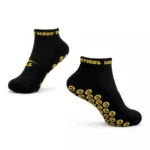
Ankle grip socks
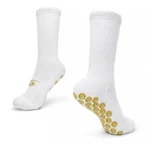
Mid-length grip socks