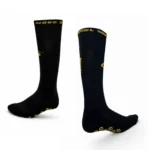

Do grip socks really work?
Anyone delving into grip socks will sooner or later encounter the same debate. According to some, grip socks are an indispensable part of every sports kit, while others dismiss them as ordinary sports socks with some rubber studs on the bottom. Especially now that grip socks are appearing increasingly often in professional football, padel, hockey, and fitness, many athletes wonder whether there are actual benefits or if it is primarily a clever marketing trick.
A valid question. Because if grip socks really work, why are more and more professional athletes wearing them? And if they don't work, why have they grown from a niche product to almost a standard part of the football world in a relatively short time?
In this blog, we look at exactly what grip socks do, what scientific research says about them, and why more and more athletes are choosing to swap regular sports socks for grip socks.
What do grip socks actually try to solve?
To understand whether grip socks work, we must first look at the problem they try to solve.
During sports, significant forces are generated between your foot, your sock, and your shoe. Especially in sports involving a lot of sprinting, braking, and changing direction, a lot of stress is placed on the feet. Think of football, hockey, tennis, padel and fitness.
At such moments, something happens that many athletes don't even consciously notice: the foot moves inside the shoe.
Even when a shoe fits well, the foot can shift slightly during a sprint or a quick turning movement. That may seem insignificant, but it is precisely those small movements that can lead to less control, a less stable feeling, and ultimately even blisters.
Grip socks are designed to limit that movement. By creating extra grip between the sock and the shoe, the foot stays better in place during explosive movements.

Why do feet actually slide around in shoes?
Many athletes think that sliding around in shoes only happens when shoes are too big. In reality, it is a bit more complicated.
During pushing off, braking, and changing direction, horizontal forces are generated that attempt to move the foot inside the shoe. Especially when feet become warm and start to sweat, the friction between the sock and the shoe decreases. As a result, the foot can move more easily.
You notice this, for example, when you feel during a match that your foot is not quite fully secured in the shoe. Sometimes this is barely noticeable, but sometimes it leads to a feeling of insecurity during fast movements or to irritation and blisters.
That is precisely why professional clubs pay so much attention to everything related to grip, stability, and foot control.
What does scientific research say?
The great thing about grip socks is that actual scientific research has now been conducted on them.
In a research from 2022 Scientists from Nottingham Trent University investigated the effect of grip socks on sports performance, stability, and foot movement within the shoe. The researchers discovered that the grip socks created almost twice as much friction as regular sports socks. Additionally, it was found that the foot shifted less inside the shoe and that participants completed a slalom course faster when wearing grip socks.
What was particularly interesting is that the researchers concluded that grip socks could improve the agility of athletes because the foot remained more stable during rapid changes of direction.
A second study from 2023 focused specifically on footballers. There, too, researchers observed that socks with more grip resulted in better traction between foot and shoe and that players felt themselves faster during football movements. The final time of the performance test did not improve significantly in that study, but the researchers did conclude that the relationship between grip, stability, and performance is strongly dependent on the overall interaction between shoe, sock, and player.
In other words: science does not show that grip socks automatically make you faster, but it does show that they influence the way your foot behaves in the shoe and how stable an athlete feels during movements.
Why do so many professional footballers wear grip socks, then?
An interesting follow-up question is why grip socks are visible almost everywhere in professional football these days.
Watch matches during the 2026 World Cup, the major European leagues, or international tournaments, and it is immediately striking how many players are now wearing grip socks. While grip socks used to be used primarily by a small group of players, they seem to have become almost the norm these days. That is not surprising. Professional clubs have sports scientists, performance coaches, data analysts, and equipment experts at their disposal. Every sprint is measured, every physical improvement is analyzed. Every potential performance advantage is examined.
When a product yields no benefit for years, it usually disappears from top-level football of its own accord. With grip socks, however, the exact opposite seems to be happening. That does not mean that every player experiences exactly the same benefits, but it does say something when thousands of professional athletes consciously choose them.
For more on this, you can also read our blog: Why do professional footballers wear grip socks?
Do grip socks work only physically or mentally as well?
An aspect that is often overlooked is the mental effect. Athletes do not perform based solely on physical attributes. Confidence plays at least as important a role. When a player feels that he has more control over his movements, it can influence the way he moves, accelerates, and reacts.
Interestingly, researchers also observed that participants experienced more grip, stability, and control when wearing grip socks. That does not mean the effect is all in the mind. In fact, the studies show that physical differences are measurable as well. However, it does show that feeling and performance often go hand in hand. A player who feels more stable will often move with more conviction.
Are grip socks only useful for football?
Although grip socks have gained their popularity primarily within football, the benefits are certainly not limited to this sport.
Any sport involving sprinting, braking, turning, or explosive movements can benefit from extra grip between the foot and shoe. That is why you see grip socks increasingly often these days among padel players, field hockey players, tennis players, fitness enthusiasts, and even kart drivers.
The underlying principle remains the same: the less unwanted movement between foot and shoe, the greater the sense of control.
So, do grip socks really work?
Based on current scientific research, the answer seems clear: yes, grip socks work.
It does not mean that a grip sock suddenly makes you faster, stronger, or more technical. However, studies do show that grip socks can increase the grip between the foot and the shoe, reduce movement of the foot inside the shoe, and improve the sense of stability.
That probably explains why grip socks are nowadays not only worn by professional footballers, but are also increasingly used by athletes in other disciplines.
Ultimately, the best way to determine if grip socks work for you remains surprisingly simple: experience it yourself.
Experience the difference for yourself
Curious why more and more athletes are choosing grip socks?
Check out the GXOX grip sock collection and discover for yourself what extra grip, stability, and control can mean during training, competitions, and intensive workouts.
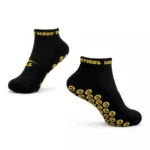
Ankle grip socks
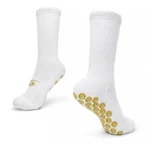
Mid-length grip socks