
Why do footballers cut their socks? Everything about grip socks and the rules of the game.
Watch any random match in the Eredivisie, Champions League, or Premier League these days, and chances are you will see it. A player pulls up his sock, straightens his shin guard, and suddenly a different piece of fabric appears under the club sock. Or perhaps you see tape around the ankle, or wonder why the sock actually looks different than it used to.
Anyone noticing this for the first time often asks the same question: why do footballers actually cut off their socks?
About fifteen years ago, this was still a rare sight. Nowadays, it is almost the standard in professional football, and on amateur pitches too, you see more and more players with cut-off football socks, loose sleeves, and grip socks. For some, it has become so commonplace that they no longer even know why this trend ever originated.
However, there is a clear reason behind it. After all, professional footballers do not cut their socks because it looks cool or because it is a new fashion trend. They do it because they want to combine the benefits of grip socks with the official club sock that must be worn according to the dress code.
In this article, we explain why more and more footballers are cutting off their socks, how grip socks play an important role in this, what the official rules say about it, and how you can do this correctly yourself.
Why do footballers cut their socks?
The short answer is simple: to be able to wear grip socks.
Virtually every professional club provides its players with official match socks that are part of the kit. These club socks are designed to match the shirt and shorts and ensure that the entire team has a uniform appearance. While in the past hardly anyone questioned this, players began to delve deeper into the performance of their equipment. Football boots became lighter, shin guards smaller, and socks also came under close scrutiny.
More and more players discovered that grip socks for football can create extra grip between the sock and the football boot. This can help reduce unwanted movement of the foot inside the shoe.
The solution turned out to be surprisingly simple. The foot section of the official club sock was cut off. Next, the player put on his grip socks first, and then only the top part of the club sock over them. From the outside, it still looked as if he was wearing the official match sock, while in reality, his foot was inside a grip sock.
What started as a solution occasionally seen on a professional player grew into a trend that spread rapidly across the football world. Nowadays, you see this way of wearing it at virtually every level, from the Champions League to amateur pitches on Saturday mornings.
Why do footballers actually wear grip socks?
To understand why players started cutting off their football socks in the first place, we must first look at the reason why grip socks have become so popular.
During a football match, a player constantly changes direction. There is sprinting, braking, turning, and pushing off. With all these movements, your feet try to push off against the inside of your shoe, as it were. If your foot shifts even slightly during this process, it can compromise the feel of your shoes.
Grip socks are designed to limit that movement as much as possible. Thanks to the grip zones on the bottom, there is more contact between the sock and the insole of the shoe. As a result, the foot stays better in place during explosive actions.
However, that does not mean that a grip sock automatically makes someone faster or gives them better technique. Football remains, of course, primarily a matter of talent, training, and experience. Many players do indicate, however, that a grip sock provides a more stable feeling inside the shoe, allowing them to move with more confidence.
There is a second advantage as well. Less movement between foot and shoe generally also means less friction. In a previous article, we already explained in detail how those sliding movements can contribute to the formation of blisters.
Article: Do grip socks prevent blisters? This is what practice and science say.
We have also previously explained why feet can slide around in sports shoes at all and what role socks play in this.
Article: Why do your feet slide inside your shoes?
It is precisely that combination of extra grip, more stability, and a more comfortable feeling in the shoe that has ensured that grip socks are nowadays worn not only by professional footballers, but also by an increasing number of amateur footballers.
If you want to know more about the fit and which size you need, you can read about it in this article. Which grip socks are suitable for football and what to look out for when choosing them.
When did this trend actually start?
Interestingly enough, the idea of grip socks hasn't been around for very long at all. Although there have always been players who experimented with different types of socks, the big breakthrough only began in the 2010s.
More and more professional footballers switched to special grip socks, and supporters soon noticed something. Some players were suddenly walking around with tape around their ankles or with socks that clearly appeared to consist of two separate parts. At first, it was thought that this was purely for appearance, but it soon became clear that there was a practical reason behind it.
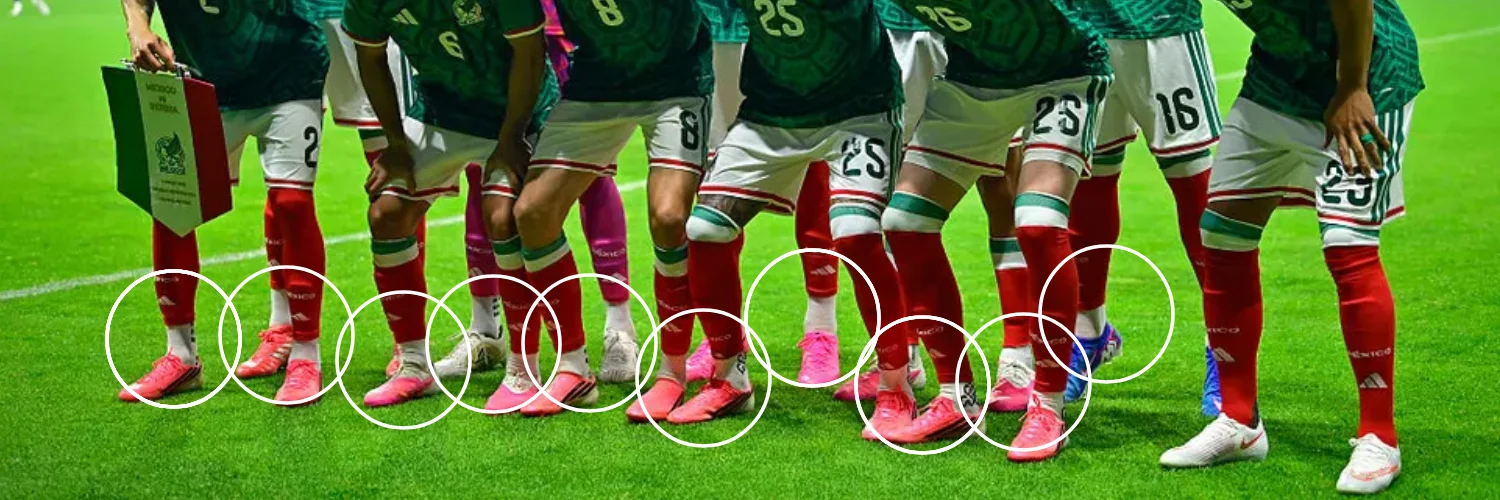
As is often the case in football, amateur players soon followed the pros' example. At first, you only saw it among high-level players, then in the first teams of amateur clubs, and by now it is a familiar sight at virtually every sports ground. Where you used to see perhaps one player with cut-off socks, nowadays there are sometimes five or six within the same team.
That clearly shows how much influence professional football has on the choices amateurs make. Not every trend lasts long, but wearing grip socks seems to be much more than a temporary hype by now. Simply too many players have become convinced of that.
Are you actually allowed to cut off your football socks according to the rules?
This is perhaps the most frequently asked question regarding grip socks. After all, if every player cuts his football socks, is that actually allowed?
The short answer is: Yes, provided you comply with the dress code.
According to the rules of the IFAB (International Football Association Board), on which the KNVB also bases its regulations, players must wear a uniform team kit. This means, among other things, that the visible socks must have the same main color as those of the rest of the team.
However, the rules nowhere state that a player is required to wear the foot section of the original club sock. The main point is what is visible during the match. Therefore, many players choose to replace only the lower part of the club sock with a grip sock, while the upper part – which is visible to the referee and opponents – is simply retained.
That is precisely why you often see tape or a sleeve around the ankle. This neatly connects the different parts, so that the whole thing looks like one sock.
At amateur clubs, interpretations can sometimes differ slightly. Some clubs are fine with it, while others prefer players to wear the full original club sock. It is therefore wise to check beforehand what is customary within your club. In practice, however, wearing grip socks in combination with the club sock rarely causes problems.
How do footballers cut off their socks?
Anyone wanting to wear grip socks for the first time often wonders exactly where to cut the sock. Fortunately, that is less complicated than it might seem.
Virtually all players cut off only the foot section of the club sock. The upper part, which runs over the shin and calf, remains completely intact. This preserves the appearance of the official kit.
Most players cut the sock just above the ankle. This leaves enough fabric to pull the club sock neatly over the grip sock later. If you cut too low, the transition may not fit as nicely. If you cut too high, it becomes more difficult to keep the club sock properly in place.
The first time, it is better to remove slightly less fabric than you think you need. You can always cut off a small extra piece, but a sock cut too short is, of course, beyond repair.
How do you wear grip socks under your football socks?
When the club sock has been cut off, putting it on is actually very simple.
You start with the grip sock. You wear it like any normal sports sock. Next, pull the top part of the cut-off club sock over the grip sock so that it fits neatly over your shin guards and calf.
Many players then use a piece of sports tape around the ankle. This ensures that both parts remain properly joined together during sprinting, turning, and sliding. Moreover, the overall look is neat, and the transition between the two socks remains barely visible.
Anyone who plays matches regularly often notices that, after a few times, it takes hardly any more time than putting on a normal football sock.
When is it time to replace your sports socks?
No matter how much we might wish it were, no sports sock lasts a lifetime. Eventually, all materials experience wear and tear. That is not a problem; it simply means your sock has done its job.
A small hole at the toe is usually the clearest signal, but there are often earlier indications that a sock needs replacing. The fabric feels thinner, the fit becomes looser, or the sock slips down further and further during exercise. With grip socks, you may also notice that the grip dots become less effective as they slowly wear down after many intensive training sessions.
For recreational athletes, a high-quality sports sock can last for years. However, if you train several times a week or play matches regularly, a sock naturally takes much more of a beating. Therefore, view sports socks just like your sports shoes. You eventually replace those too, because performance and comfort gradually decline.
It is tempting to keep walking for a few more weeks in that one favorite sock that now has a hole in it. We have probably all done that at some point. However, that is not always wise. As soon as the fabric thins, the protection for your foot decreases. This increases the risk of extra friction, irritation, and ultimately blisters.
Long grip socks
Mid-length grip socks
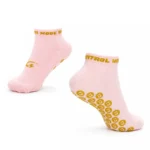
Ankle grip socks
And what about sleeves?
In addition to cut-off football socks, you are also seeing so-called sleeves more and more often. These are separate socks without a foot section that are specifically designed to be worn over a grip sock.
The advantage of this is clear. You no longer have to cut off official club socks, and when a sleeve gets damaged, you only replace that part. Many professional clubs therefore use specially made sleeves that match the match kit in color exactly.
Among amateur footballers, however, you still often see that the original club sock is simply cut off. That is a simple solution, costs little, and ensures that the color always matches the rest of the kit perfectly.
Which option you choose is primarily a matter of personal preference. The end result is virtually the same in both cases: you benefit from the advantages of grip socks, while to the outside world you still look as if you are wearing the official club sock.
Is cutting off your football socks interesting to everyone?
Not every footballer will notice an immediate difference. If you play a recreational game with friends every now and then, chances are you don't think much about it.
However, if you train several times a week or play matches regularly, small details become increasingly important. Good shoes, a comfortable fit, and quality socks all contribute to how comfortable you are on the field.
That also explains why grip socks are no longer reserved for professional footballers. More and more youth players, amateur footballers, and avid recreational players are choosing to cut off their club socks and combine them with grip socks. Not because it is “in” these days, but simply because they find it more comfortable to play.
Ultimately, it remains a personal choice. Some players swear by it, others notice less of a difference. But one thing is clear: cutting off football socks is no longer a striking phenomenon. For many footballers, it has become a fixed part of their match preparation.
Conclusion
Anyone seeing a professional footballer with cut-off socks for the first time might easily think it is a fashion trend. In reality, there is a very practical reason behind it.
Footballers cut off their club socks to wear grip socks without compromising the appearance of the official kit. By removing only the foot section of the club sock, they can benefit from the advantages of a grip sock, while the visible part of the match sock remains intact. This way, they comply with dress codes while simultaneously retaining the comfort and feel that many players seek.
However, that does not mean that every footballer will automatically play better with grip socks. Ultimately, technique, training, and experience remain the most important factors on the football pitch. Many players do indicate, however, that they experience more stability and a more comfortable feeling in their football boots. That is precisely why you see this style of play at almost every level nowadays, from youth teams to the biggest leagues in the world.
Are you curious exactly how grip socks work, or do you want to experience for yourself why more and more footballers are choosing them? Then take a look at our collection. football grip socks and discover which version best suits your playing style.
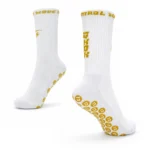
White grip sock
Black grip sock
Yellow grip sock
Frequently asked questions about holes in socks
Read also
Do you want to know more about grip socks and football? Then check out our other articles as well:
- Do grip socks really work?
- Do grip socks prevent blisters? This is what practice and science say.
- Why do your feet slide inside your shoes?
- What are grip socks?
- Why do professional footballers wear grip socks?
- Always holes in your socks? This is why (and how grip socks can help)
Sources
This article uses information from the official rules of the International Football Association Board (IFAB), the guidelines of the KNVB, and general information about sports equipment and grip socks.