
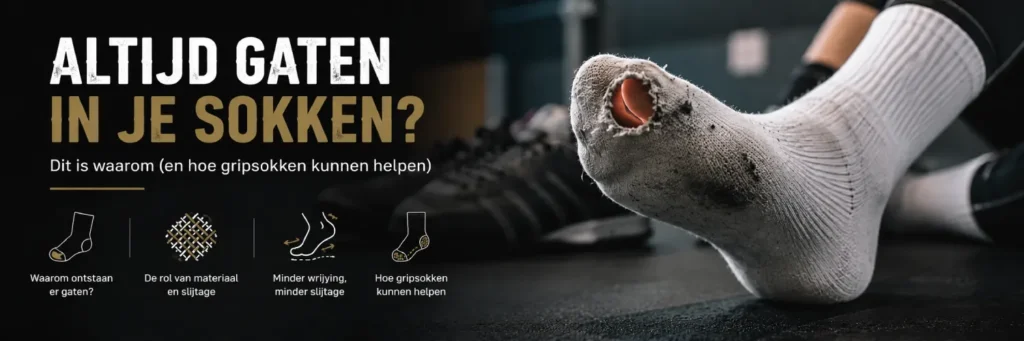
Always holes in your socks? This is why (and how grip socks can help)
You undoubtedly know the feeling. You put on your favorite sports socks in the morning, slip your foot in, and feel it immediately. Another hole. And of course, that hole is in exactly the same spot as last time, usually near your big toe. What do you do next? You fold the sock in half a little so the hole disappears under your foot and decide it can still last for another workout. We all do it, even though most would rather not admit it 🤣
Yet, it is actually quite remarkable. Why do holes almost always appear in the same places? Why does one sock seem worn out after just a few months, while another lasts for years? And how is it that some athletes have to buy new socks every few months, while others hardly suffer from wear and tear?
The short answer is that socks don't just fall apart. Behind a small hole in your sock lies a surprising amount of engineering. The way you walk, the fit of your shoes, the materials a sock is made of, and even how you wash your socks all influence their lifespan. This applies to regular sports socks, but just as much to grip socks.
In this article, we explain why socks wear out, why holes almost always appear in the same places, and what you can do to ensure that your sports socks last significantly longer.
Why do holes almost always form on your big toe?
If you have a drawer full of old socks, you probably don't have to look long for a pattern. In most cases, the first hole is at the big toe. That is no coincidence.
While walking or playing sports, the big toe absorbs a large portion of the forces released when you push off. With every step, your foot pushes against the front of your shoe, stressing the fabric of your sock. This doesn't happen just a few times, but thousands of times during a training session or competition. Over time, the fibers become fatigued and thinner, until eventually the first small hole appears.
Many people think that this is solely because their toenails are too long. While a sharp nail can certainly accelerate wear, that is rarely the only cause. Even athletes with perfectly groomed feet get holes in their socks sooner or later. The real culprit is the combination of pressure, friction, and constant movement.
That also explains why one brand of socks wears out much faster than another. When the yarns used are weaker or the fabric is thinly woven in vulnerable areas, the fibers simply have to endure more. After thousands of repetitions, that difference suddenly becomes visible in the form of a hole.
Not only friction, but especially movement causes wear.
When people think of worn socks, they often think of friction. That makes sense, because it feels as if your foot is constantly rubbing against the inside of your shoe. However, scientific research shows that the story is a bit more complicated.
While exercising, your foot constantly moves a small amount inside your shoe. Sometimes barely visible, but thousands of times in a row. Every time you push off, sprint, turn, or brake abruptly, small shearing forces are created between your foot, your sock, and your shoe.
That movement not only ensures the well-known blisters that we in a previous article wrote about, but also stresses the fibers of your sock. Think of it as a paperclip that you keep bending back and forth just a little bit. Once, nothing happens. A hundred times, neither. But after thousands of movements, the metal eventually breaks. Essentially, the same thing happens with textiles. The fibers are not torn apart all at once, but slowly lose their strength until the fabric gives way.
That is precisely why sports socks often wear out faster than regular socks. During a walk, your foot moves relatively still. During a football match or a game of padel, the same sock has to withstand an enormous amount of acceleration, braking, and turning movements in an hour and a half. That simply demands much more from the material.
Your shoes also play a bigger role than you think.
When socks wear out quickly, they usually get the blame. However, the cause is by no means always with the sock itself.
A shoe that is just slightly too big gives your foot more room to move. This creates extra shearing forces and places greater stress on the fabric of your sock. Conversely, a shoe that is too small can cause constant pressure on the big toe, causing the fibers to wear out faster at precisely that point.

The inside of your shoe also plays a role. Damage to the lining, loose seams, or a rough finish can unknowingly shorten the lifespan of a sock. Some athletes buy new socks several times a year, while the real cause actually lies in their shoes.
That is why it is always wise not only to look at your socks when another hole appears, but also to take a critical look at the inside of your sports shoes. Sometimes the solution is closer than you think.
Why do some socks last much longer than others?
Not every sock is the same. That might sound obvious, but when you place two sports socks side by side, you often see hardly any difference. Nevertheless, lifespans can vary enormously. This has everything to do with the materials, the construction, and the way a sock is developed.
Cheaper sports socks often consist largely of cotton. Cotton feels comfortable, but it also has a disadvantage. It absorbs a lot of moisture, and the fibers are less durable than synthetic materials such as polyamide. During intense exercise, these fibers are constantly under stress. The more often this happens, the faster the fabric thins.
That is why you see that high-quality sports socks almost always use a combination of materials. Polyamide ensures high wear resistance, cotton offers comfort and moisture absorption, while elastane ensures that the sock fits snugly around the foot. So it is not about one miracle material, but about the right balance.
At least as important is the way a sock is knitted. In the areas where the stress is greatest, such as the heel and toes, a manufacturer can opt for a denser weave or extra reinforcement. That might seem like a small detail, but it is precisely there that the difference is often made between a sock that is worn out after a few months and one that lasts much longer.
Do grip socks actually last longer?
That is perhaps the question many athletes are curious about. The honest answer is: it depends.
A grip sock automatically lasts longer because it has grip dots on the bottom. The grip itself provides an extra wear-resistant layer at the bottom of the sock. Additionally, the lifespan is also determined by the quality of the yarn, the construction of the sock, and how you handle it.
That is why, in practice, you often see that high-quality grip socks last 3 to 4 times longer than simple sports socks. There is a logical explanation for this. Manufacturers who develop grip socks for intensive use usually opt for more durable materials and a sturdier construction. After all, they know that their socks are used during explosive sports where the load is much greater than during everyday use.
There is a second effect that is often overlooked. Because grip dots help limit movement between the foot and the shoe, the fibers of the sock are also less exposed to constant sliding motion. That does not mean that a grip sock will never wear out, but under comparable conditions, less movement can also mean less stress on the material.
At GXOX, we have taken that into account from the very beginning. Our grip socks They have been developed for athletes who train or play matches multiple times a week. That is why we combine a durable polyamide yarn with a soft cotton footbed and a snug fit. Not because this makes a sock indestructible—for that simply does not exist—but because high-quality materials and a well-thought-out construction contribute to a longer lifespan.
Can you prevent holes from forming in your socks?
It will probably never be possible to prevent it entirely. Even the best sports socks will eventually show wear and tear. That is simply part of owning a product that is subjected to thousands of stresses during sports.
However, you can extend the lifespan surprisingly easily.
It starts with shoes that fit well. The less your foot moves inside the shoe, the less strain there is on the fabric of your sock. Additionally, it is wise to keep your toenails short and smooth. This prevents sharp edges from constantly pressing against the same spot in the fabric.
Washing also makes more of a difference than many people think. High temperatures and the dryer cause elastic fibers to lose their stretch faster. Therefore, preferably wash sports socks at a lower temperature (30 degrees) and let them air dry. This is not only better for the lifespan of the sock, but also for the grip and the fit.
Finally, it pays to invest in quality. A cheaper sock might seem attractive when you buy it, but if you have to replace it twice as often, you often end up paying more in the long run. As the old saying goes: cheap can sometimes be expensive. And let's be honest, saying goodbye to your favorite sports socks every few months is simply a waste.
When is it time to replace your sports socks?
No matter how much we might wish it were, no sports sock lasts a lifetime. Eventually, all materials experience wear and tear. That is not a problem; it simply means your sock has done its job.
A small hole at the toe is usually the clearest signal, but there are often earlier indications that a sock needs replacing. The fabric feels thinner, the fit becomes looser, or the sock slips down further and further during exercise. With grip socks, you may also notice that the grip dots become less effective as they slowly wear down after many intensive training sessions.
For recreational athletes, a high-quality sports sock can last for years. However, if you train several times a week or play matches regularly, a sock naturally takes much more of a beating. Therefore, view sports socks just like your sports shoes. You eventually replace those too, because performance and comfort gradually decline.
It is tempting to keep walking for a few more weeks in that one favorite sock that now has a hole in it. We have probably all done that at some point. However, that is not always wise. As soon as the fabric thins, the protection for your foot decreases. This increases the risk of extra friction, irritation, and ultimately blisters.
A good sock is ultimately cheaper
At first glance, cheaper sports socks seem like a smart choice. For the same amount, you sometimes buy two or even three pairs. However, that story tells only half the story.
When a sock wears out faster, slips down more often, or loses its shape, you will replace it sooner. Ultimately, you end up buying new socks more frequently. A high-quality sports sock might cost a little more, but it often remains comfortable for longer and retains its shape better.
There is another factor to consider. While exercising, you actually never consciously think about your socks. At least, not as long as they function properly. It is only when your foot starts to slide, a sock slips down, or a hole appears that you realize just how much influence such a small component actually has on your comfort.
That is precisely why more and more athletes are investing not only in good shoes, but also in good socks. Because if the connection between your foot and your shoe is not optimal, even the best sports shoe struggles to do its job properly.
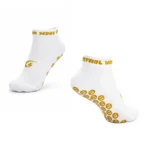
Ankle grip socks
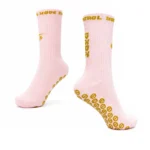
Mid-length grip socks
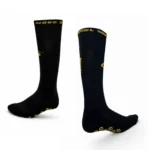
Long grip socks
Conclusion
A hole in your sock rarely appears out of nowhere. It is almost always the result of thousands of repeated movements, pressure points, shearing forces, and wear and tear on the fibers. How quickly this happens depends on various factors, such as the fit of your shoes, the way you move, the material of the sock, and the quality of the construction.
Although no sock is completely wear-resistant, you can significantly extend their lifespan. By wearing shoes that fit well, washing your socks correctly, and choosing high-quality materials, your sports socks will remain comfortable for longer and generally last longer.
For athletes who train or play matches multiple times a week, a high-quality grip sock can be an interesting choice. Not because grip socks are indestructible, but because they are specifically developed for intensive use and designed to limit movement between the foot and the shoe. This not only contributes to greater comfort and stability but can also help reduce the load on the sock itself.
In short: the next time you discover a hole near your big toe again, you will know it is no coincidence. And perhaps then it is not only time for a new pair of socks, but also a good moment to take a critical look at the quality of the socks you are wearing.
Frequently asked questions about holes in socks
Read also
Do you want to know more about grip socks and how they can improve your sports performance? Then check out our other articles as well: