

Football boots that are too big? This is why your child slips (and how to fix it).
Why parents consciously choose a size larger
There is a moment that almost every parent recognizes. You are standing in a sports store, your child is sitting on a bench wearing new football boots, and you look at them with a mixture of doubt and reason. They seem to fit well, perhaps even perfectly, but somewhere in the back of your mind, that one thought is playing: he will grow out of them in no time.
And so you ask again. “Isn’t this too tight? Can they still move up a bit?” The salesperson nods, your child shrugs, and in the end, you choose that one size larger after all. Not because it feels better, but because it makes sense.
The hidden problem: your foot slides in the shoe
A football boot should fit the foot well. Not too tight, but enough so that the foot has as little unwanted space as possible to move inside the shoe. In a shoe that is just slightly too big, extra space is created. As a result, the foot can slide around inside the shoe more easily during sprinting, pushing off, and turning.
They are millimeters, but it is precisely those millimeters that cause the shoe and the foot to no longer function as a single unit.
And that is exactly where the difference lies. A good football boot is not a loose shell; it is an extension of the foot. Everything you do is transmitted directly. As soon as there is any play in that, a slight delay arises between intention and execution. Not enough to bring the game to a standstill, but enough to make it less sharp.
The role of socks in football boots
In such a situation, most attention goes to the shoe itself. That makes sense, because that is what you see and what you consciously choose. But there is another element that is often overlooked, and that plays a bigger role in this story than you might think: the sock.
A normal sock is smooth. It does what it is supposed to do—protection, comfort—but it adds nothing to stability. In a shoe that is already slightly too loose, that means the foot can continue to move freely. Not much, not extremely, but enough to create that small shift time and again.
For example, who looks at different types grip socks for football, sees that the difference often lies not in thickness or comfort, but in what happens the moment you move.
Can grip socks help if your foot slides inside the shoe?
Grip socks do not change the fit of a football boot. A boot that is clearly too big remains too big, and a well-fitting football boot therefore remains the starting point.
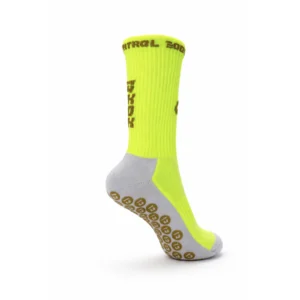
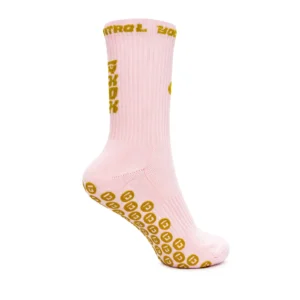
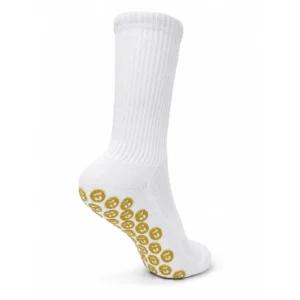
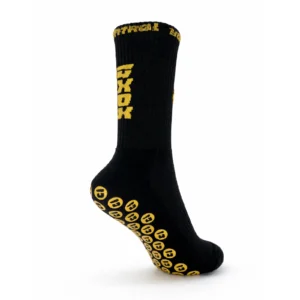
What grip socks *can* do is increase the friction between the sock and the inside of the shoe. The grip zones under the foot are designed to reduce unwanted movement inside the shoe. This can be particularly noticeable during push-offs, braking, and rapid changes of direction.
Take a look at this one black grip socks or white grip socks, there you can also see the grip pattern on the bottom in detail.
What research and practice show
What’s interesting is that this feeling isn’t just “in your head.” Studies show that something actually changes when there is more grip between the foot and the shoe.
In one study, socks with added friction were examined. It showed that players were able to generate more traction during movements like turning and pushing off, and that they felt faster during play. That sense of speed doesn’t come out of nowhere. SOURCE
Another study showed that grip socks can reduce foot movement inside the shoe, especially when slowing down or changing direction. At the same time, players were actually slightly faster in a course with many changes of direction. SOURCE
That doesn’t mean a sock suddenly solves everything. But it does show that those small movements inside the shoe—ones you normally don’t think about—do have a real impact.
The conclusion: the problem is not just in the shoe.
Ultimately, therefore, it is not just about choosing a shoe that is a size larger. That choice is often practical and understandable. It is about what happens afterward, and whether you accept or correct that effect.
For while that extra space may be inevitable, the sliding that results from it is not.
For many parents, that insight only dawns when they see or hear the difference for themselves. When a child suddenly says that it feels better. That they stand more firmly. That turning is easier. No big words, no technical explanation, but a simple difference that makes itself felt in the game.
A well-fitting football boot always remains the starting point. Therefore, do not buy shoes that are unnecessarily large, expecting that grip socks can solve the extra space.
Does your child notice that their foot shifts inside the shoe while playing football, despite a good fit? Then grip socks can be an additional way to create more friction between the sock and shoe and reduce unwanted movement.